





The Problem Everyone Ignores
Your requirements document just created three different interpretations of the same feature. Dev read it one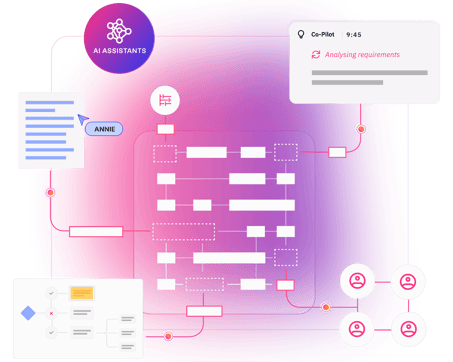 way, QA read it another, and the User meant something entirely different. By the time anyone noticed the misalignment, the feature had already been developed and the User and QA start reporting bugs.
This is where most bugs start: not in the code, but in the requirements. Textual requirements are ambiguous by nature, which means it's not a writing problem at all, it's a communication problem. That communication mismatch cause delay and cost real money to fix downstream when everyone eventually discovers the users’ requirements have been incorrectly developed.
Why Text Doesn't Work for Logic
A textual description of a problem often relies on implied knowledge of how processes and technology work as well as an understanding of the data as it moves through the system. Text, by its very nature, is ambiguous especially when different development functions are spread across different time zones. In other words, Text is problematic when describing logic as it forces local interpretation, it also needs to be crystal clear in describing all the logic gates within a requirement.
When you write requirements as prose, people fill in the blanks with their own assumptions. Dev makes one assumption about what a feature should do, QA makes another, and the actual logic remains unclear because everyone is reading their own interpretation into the words.
The deeper problem is timing. By the time you discover the misalignment, engineering has already started building. Requirements have been translated into code and test cases have been written. Changing the requirements now means rework, delays, and frustrated teams. This is technical debt, but the worst kind because it's written into your requirements document on day one and propagates through every downstream decision.
The Fix: Design Requirements Instead of Writing Them
Stop treating requirements like a documentation exercise and start treating them like architecture. Visual modelling using standard BPMN notation lets you design requirements instead of writing them. You map out the actual logic including decision gates, process flows, expected results, end states, and data references. The result is clear, visual logic that everyone can agree upon with no ambiguity and no room for interpretation.
Here's what changes: your requirements are no longer a static picture you look at and interpret differently. They become live logic you can interrogate directly. Harry from Curiosity demonstrated this recently by taking a payment processing workflow involving account selection, payee creation, amount validation, and different payment schemes. In a BPMN model, all that complexity becomes a clear visual flow where Dev knows exactly what to build and QA knows exactly what to test because there's no room for misinterpretation.
Start With What You Already Have
Most organizations have piles of old documentation including user stories, process guides, and legacy system documentation scattered throughout their organization. These documents are often confusing and disconnected, yet they represent the actual understanding of how your system works. You don't have to start from scratch because modern modelling tools can import all of it automatically.
The document importer is a lifesaver for technical debt. Feed it your old process documentation and it parses it automatically to build structured BPMN models. You go from having scrappy stories scattered in folders to having a single end to end model, incorporating common sub models, everyone can see and agree on. This approach matters because the fastest way to design requirements is to recover the requirements your system already embodies, rather than trying to invent them from nothing.
Use AI as an Accelerator, Not an Owner

Everyone's asking whether AI can just generate requirements automatically, but the short answer is no. The longer answer is that AI is probabilistic by nature, meaning it makes educated guesses rather than deterministic decisions. Requirements need certainty, which is something AI alone cannot provide.
What AI is great at is accelerating the design process. AI agents can review your model and flag ambiguities or missing scenarios. For example, they might ask "What happens when out-of-stock items are picked? Your model does not cover that scenario clearly. Should we add it?" You decide whether to implement the suggestion, you own the final model, and AI simply speeds up the discovery process. The workflow looks like this: import old documentation, then have AI agents find gaps and ambiguities, then you validate and fix those findings, and finally you have a real, verified requirements model that everyone agrees on. In other words, the human is in the loop, and AI becomes a massive and powerful time saver.
One Model Generates Everything
Once you have a clear model, it becomes your sole source of truth for the entire development process. You use the same model to generate user stories, test cases, and test data, which means everything comes from the same logic and everything stays perfectly aligned throughout the project.
A global accounting firm did exactly this and saw remarkable results. Their old process took 70 hours to manually convert requirements into test cases, but after moving to visual modelling and automated generation, that time dropped to 45 minutes. Everything is generated from one model, the logic remains consistent, misalignment disappears, and the entire process becomes 80% faster.
You can also query the model directly instead of hunting through documentation. If you ask, "What are all the potential failure paths for a bill processing failure? " The model tells you instantly that there are seven and the logic gates that cause the bill to fail. There's no guessing and no inconsistency because the answer is built into the logic itself.
What Actually Changes
When your requirements are a designed model instead of a written document, several things improve immediately. Development teams build with certainty because they are not guessing at what ambiguous requirements mean. QA writes or generates tests with complete alignment to the requirements because they are testing the same logic the model describes. Product stays in control of the process because if requirements change, you update the model once and everything downstream updates automatically without manual rework.
Business rules also become queryable, which means you can ask your model questions and get instant answers rather than hunting through documentation. Most importantly, bugs caused by ambiguous requirements simply do not happen anymore because ambiguity is designed out before any code is ever written.
The Real ROI
AI driven Visual modelling is not slower than writing requirements, it is faster. It's not more complex to implement, it's clearer for everyone involved. Most importantly, it's not adding work to your process, it's replacing work like manual test case design, user story rework from misaligned requirements, and discovery of bugs in production.
Every team we work with that makes this switch reports the same outcome: requirements take less time to get right, and everything downstream moves faster. Everyone's building from the same logic instead of from their own interpretations. The efficiency gains compound as the project progresses.
The Future Isn't Written. It's Designed.
The choice is straightforward. You can keep writing requirements as walls of text, accept the ambiguity that comes with it, and pay the cost in rework and bugs discovered in production. Or you can design your requirements visually and create a stored, version-controlled model that everyone agrees on. The model acts as framework and the model structure acts as single point of truth that AI can reliably use. AI is then under your control suggesting and improving, with the development team as the arbiter of the correctness of the application in the real world. The models then create aligned user stories, tests, and test data automatically with measurable coverage.
One approach asks your team to guess and interpret. The other removes the guessing entirely by making requirements explicit, visual, and queryable. The best teams around have already made this switch. They stopped writing requirements and started designing them.