




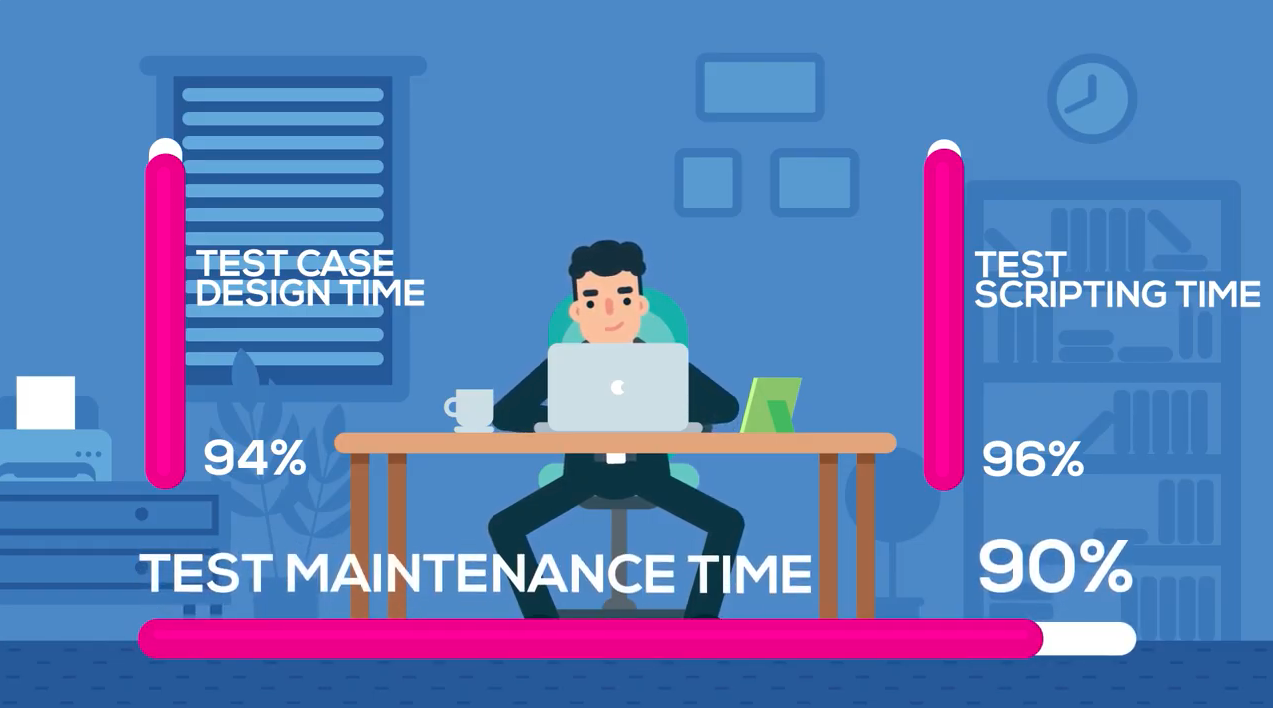
Your product requirements just changed. It was a small adjustment to the payment selection scheme to satisfy a new internal request. Development updated the code in an hour. On the quality side, though, you're staring at 71 manually created test cases! The moment that requirement changed, some, none or all those 71 cases became obsolete.
This is where testing velocity starts to slow: the gap widens between what the software does and what your tests can validate. In an attempt to catch up, many teams throw probabilistic AI at the problem. They use language models to generate more tests, hoping that more coverage means better quality. But this doesn't work. Pure AI is a guessing engine. It generates what looks like a valid test, but it lacks the mathematical certainty required for professional-grade software. Professional testing requires, AI assisted but fully deterministic results where a test is either mathematically correct based on logic, or it isn't.
The industry is obsessed with generating tests faster, but that's solving the wrong problem. You don't need more disposable scripts. You need to stop the bleeding caused by maintaining test cases manually every time requirements change.
The Hidden Cost of Manual Test Maintenance – Test Cases never Die
Maintenance is the silent killer of testing velocity. It's the cost you don't notice until your release schedule hits a wall. When you treat test cases as static snapshots, you create maintenance debt that compounds with every release. As requirements evolve, you end up with test cases that never die, obsolete scripts that stay in the suite because nobody knows what they cover or whether deleting them will break the safety net.
The Real Cost:
- Manual creation speed: Even the best tester can only produce 6-7 high-quality test cases per day.
- The change audit: Even a minor requirement changes forces someone to manually review every existing test case for impact. This takes hours and is error prone.
- Static suites can't adapt: You either over-test things that don't matter, create duplicate tests or miss critical new paths. Test suites can't expand and contract to match the actual logic.
- Engineer burnout: High-level SDETs spend 80% of their time fixing old, brittle test cases rather than designing innovative coverage.
These problems point to a deeper issue. Teams spend most of their cycle time auditing spreadsheets instead of validating new features. Manual auditing is inherently error-prone, so complex edge cases get missed. This manual process gives no clear measurable mathematical coverage metrics, release confidence is based on feeling rather than proof.
Why Manual Approaches Keep Failing
The traditional response to a requirement change is a manual rewrite cycle. Teams must hunt through hundreds of rows in a spreadsheet to identify which specific test steps are broken and manually adding in new test cases. Under deadline pressure, this leads to duplicated work as it is much easier to copy an existing test and making a minor edit.
Many fundamental types of test cases get left out, including Edge Case , Boundary and negative tests in the rush to get a feature into production.
An obvious and fundamental problem is that maintaining test cases is significantly harder than creating them. Without a central source of truth, the developer's code, the BA's requirements, and the tester's scripts will always drift apart. Manual solutions augmented by AI fail because they're static documents trying to describe a dynamic, moving target. To fix this, you must move away from maintaining lists of tests and toward a model that can firstly regenerate your entire testing suite on demand and secondly create focused tests based on the feature being changed or added.
Model-Based Testing: Visual Logic Plus AI Acceleration
The solution is a strategic shift from list-based thinking to well-established structured Model-Based Testing. A visual model establishes a common framework that development, testing, and business analysis can all cooperated on and agree upon. It turns a 40-page requirement document into a logical map everyone understands.
In this approach, an AI co-pilot acts as an accelerator rather than a replacement. It removes ambiguity from textual requirements and builds the initial model logic, while the tester remains in control, refining the model to match complex business needs.
What a Testing Model Includes:
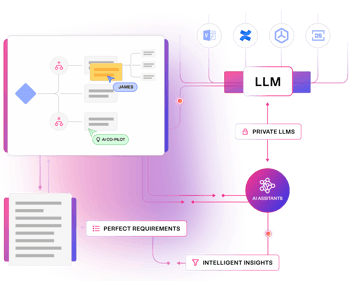
Decision gates and logic nodes represent the actual business rules and where the application logic branches based on different conditions. Equivalence classes and boundary tests ensure you're testing logic at the edges rather than random values and overlaid business constraints fine tune the harder complex logic. Instead of testing every possible amount, you model classes like "Large and small Sums", “plus or minus 0.05 cents”, "Negative Values" etc rapidly improving your application testing coverage.
Componentized sub flows mean logic like "Create New Payee" is built once and reused everywhere. If the payee creation logic changes, you update it in one place, and it ripples through every end-to-end test instantly.
Centralized seed lists and SQL integration decouple data from test steps. You can pre-populate lists using SQL so that test payees match the target and reference environments perfectly. This ensures data consistency across all tests without manual maintenance and significantly reduces the failure rate of tests.
Real Example: The Payment Processing Model
In banking and finance applications, you need absolute accuracy. You cannot rely on probabilistic guesses from AI. When you model a payment flow involving account selection, payee selection, and payment scheme selection, you use synthetic data functions to ensure robustness across scenarios.
Instead of hard-coded test amounts, you use functions to generate standard values for the happy path, decimals to check rounding accuracy, and boundary cases like a 255-character payee name to test UI and database constraints. A critical example is the "Large Sum Authentication" rule. By modelling a specific threshold where high-value payments trigger extra authentication, you ensure this high-risk rule is tested every time the model regenerates without ever manually writing a test case for it.
The 5-Minute Fix: When Requirements Change
The strategic moment happens during impact analysis. A national insurance company recently updated a requirement to include four new payment types: Instant, Scheduled, and others. In a manual world, this would require auditing every single test case to see what broke.
In the model-based world, the tester used an Update Model agent to add these payment variations to a single "Selection Scheme" node in the model. The system instantly identified that 64 existing paths were affected. Instead of spending a full day fixing those 64 cases manually, the tool used exhaustive algorithms to regenerate a brand-new suite of 279 test cases in minutes. The AI then contextually named every new path, providing full documentation of the new logic without anyone typing a single word.
The Difference:
In the manual approach, impact analysis took hours of auditing spreadsheets. In the model-based approach, impact was identified instantly. Repair time dropped from hours to minutes. Coverage accuracy went from probabilistic with human error to deterministic mathematical certainty. And test naming went from manual and inconsistent to contextual and AI-assisted.
The tester didn't fix 71 broken tests. They updated one node in a model, and the entire suite fixed itself.
Stop Fixing Tests. Start Modelling Requirements.
The maintenance nightmare isn't inevitable. You can continue paying the manual tax and watch your release velocity slow, or you can move to a model where your tests are a living reflection of your requirements rather than static snapshots.
Three Steps for QA Leaders:
First, move to visual models. Establish a single source of truth that business analysts, developers, and testers can validate together. Doing this is actually very easy, simply import all your existing test cases, any initial requirements and associated change requests and reverse engineer what you have.
Second, centralize your test data. Use seed lists and SQL-driven pre-population to ensure your data always matches your target and reference environments.
Third, dynamic regeneration. Stop finding test paths manually. Decide how thoroughly you need to test each part of your application. The model generates the appropriate test cases based on that choice.
This isn't just about generating tests faster. It's about ensuring you never have to manually fix a broken test suite again. When requirements change, your model updates and your tests regenerate automatically.
Stop fixing tests. Start modelling reality.