





Most organisations assume that masking production data makes it safe to use in testing.
But when systems are integrated across multiple platforms, masking a single field incorrectly can break entire workflows and make integration tests unreliable.
What works for an isolated application often fails when data must remain consistent across complex enterprise environments.
The Limits of Traditional Data Masking
Data masking is widely used to protect sensitive information in non-production environments. By replacing or obfuscating identifiers such as names, account numbers, or national insurance IDs, organisations attempt to create safe test datasets while maintaining realistic system behaviour.
However, masking becomes significantly more difficult when testing involves multiple interconnected systems.
In modern enterprise environments, applications rarely operate in isolation. A single workflow may involve several systems working together, each relying on shared identifiers and relationships between records.
When these relationships are disrupted, integration testing can quickly become unreliable.
Enterprise Systems Are Highly Connected
Most enterprise systems are part of a broader ecosystem.
Customer data, for example, may appear across multiple platforms including CRM systems, billing systems, transaction logs, and customer support tools.
These systems often rely on shared identifiers to connect records together. A customer ID might exist as a primary key in one system while acting as a foreign key in several others.
If data masking is applied independently within each system, these connections can easily be broken. Once the link between records disappears, integration workflows stop behaving the way they do in production.
The Referential and Business Integrity Problem
Integration testing depends on referential integrity. Data must remain logically connected across every system involved in a workflow.
To maintain these relationships, masking must be deterministic. This means that if an identifier is masked in one system, it must always be masked to the exact same value in every other system.
If different masking rules or algorithms are applied, the logical link between records disappears. The data may be technically anonymised, but the systems can no longer interact correctly.
As a result, integration tests begin to fail in ways that do not reflect real production behaviour.
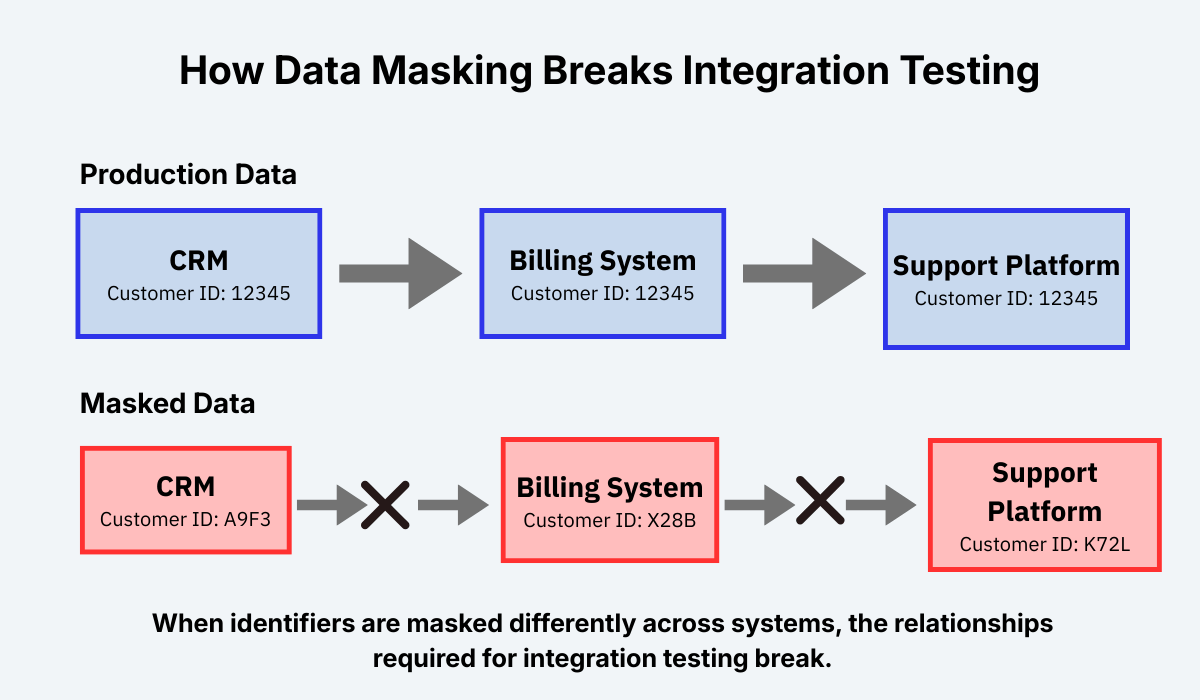
Example: The Fragmented Customer ID
Consider a simple workflow involving three systems: a billing platform, a transaction system, and a customer support platform.
Each system stores the same customer identifier so that records can be linked across the environment.
If the customer ID is masked differently in each system, the relationship between those records breaks. The billing platform may reference one masked identifier while the transaction system references another.
To a QA engineer running integration tests, this may appear as a functional defect. In reality, the application is working correctly. The issue lies in the test data itself.
Teams can spend hours investigating these failures before discovering that the root cause is inconsistent masking across systems.
The Coordination Challenge
Maintaining consistent masking across multiple systems requires careful coordination.
In many organisations, different platforms are owned by different teams. Each team may maintain its own processes for environment provisioning and data preparation.
For masking to work correctly, the same transformation logic must be applied across every system at the same time that test environments are created.
Achieving this level of coordination across multiple teams, tools, and deployment schedules can be extremely difficult.
The Complexity Problem
The challenge becomes even greater in large enterprise environments.
Legacy systems often contain thousands of tables and deeply embedded relationships that are poorly documented. Before sensitive data can be masked safely, teams must first understand where that data exists and how it flows between systems.
This investigative process is sometimes referred to as data archaeology. Engineers must dig through historical schemas and dependencies simply to identify the data that needs to be protected.
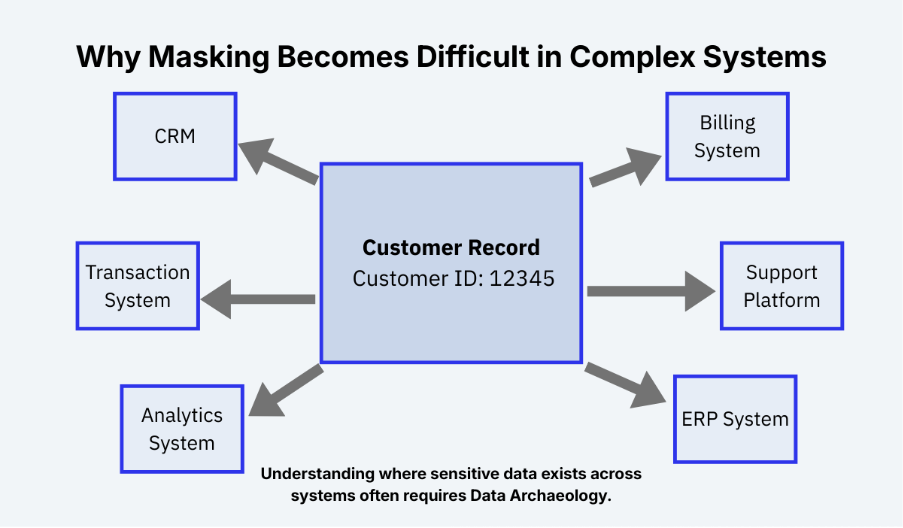 As system complexity grows, the effort required to maintain consistent masking across environments increases dramatically.
When Masking Is Not Enough
In some environments, masking production data becomes impractical.
Sensitive information may be deeply embedded across many interconnected systems, making it difficult to maintain consistency without extensive coordination and engineering effort.
Even after significant work, the resulting datasets may still introduce integration issues or compliance risks.
Because of this, many organisations are increasingly turning to synthetic test data.
Instead of masking production records, synthetic data generation creates entirely new datasets that mimic the structure and behaviour of real systems. This approach eliminates the risk of exposing sensitive information while allowing teams to maintain consistent relationships across systems.
Moving Toward Better Test Data Strategies
Integration testing often exposes the limitations of traditional data masking approaches. While masking can work well for isolated systems, it becomes far more challenging in complex enterprise environments.
To maintain realistic testing while protecting sensitive information, organisations need more deliberate test data strategies. This may involve coordinated masking processes, synthetic data generation, or structured approaches to designing test data from the start.
The goal is simple: provide development teams with production-like data that supports reliable testing while ensuring sensitive information never leaves the environments where it belongs.
Learn More
These challenges are exactly what we will explore in our upcoming webinar.
Join us to discover how organisations can create smaller, secure development databases that maintain data accuracy while protecting sensitive information.